

Have we missed something?
Help us build the database of art objects in Gdańsk by filling in the form and adding photographs.

Technique: cast bronze
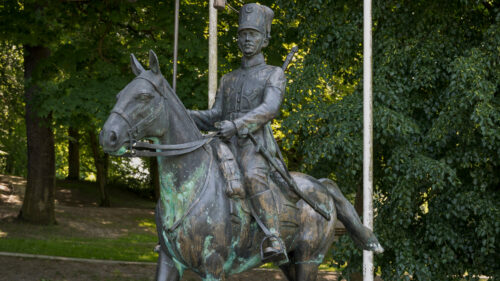
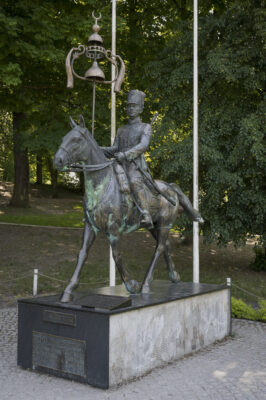
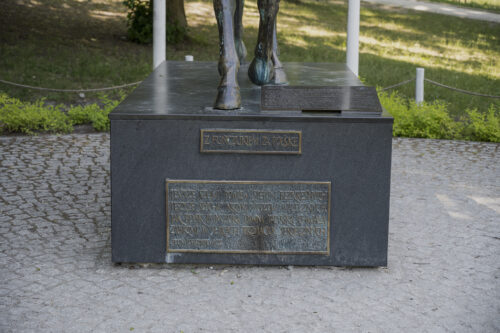
Object: Equestrian statue commemorating Tatars in Polish service. The statue is set on a low plinth made of black granite. In the front part of the plinth are two rectangular bronze plaques. The upper one reads: “With a bunchuk for Poland”. The lower one contains a fragment of a poem by Selim Chazbijewicz: “The breeze of boundless steppes rustles on, | brave leaders’ cries can still be heard. | Like the gleam on a bunchuk so the old Tatar glory | will resound in the hearts of kind friends”. At the bottom of the plinth, next to the sculpture, there is a third plaque installed at a slight angle on the stone base, which makes it easier to read the content. It features a description of the Tatar contribution to defending Polish statehood, going all the way back to the Battle of Grunwald (1410).
The compact sculpture is set on a low plinth. It does not tower over its surroundings or disturb the viewer’s perception, rather highlighting the details of the statue. It depicts a Polish soldier atop a trotting horse – an uhlan from the 1st Tatar Squadron of the 13th Regiment of Vilnius Uhlans that formed part of the Vilnius Cavalry Brigade, established in 1936 by Marshal Edward Rydz-Śmigły. The monument is flanked by four masts. The figure is depicted in a realistic manner, all details are meticulously conveyed. The Tatar is wearing a full dress uniform – the Tatar Squadron stood out, among others, because of the headdress. Instead of the four-cornered rogatywka hat, Tatars wore oblong, high-crowned kalpaks. The kalpak featured clear emblems: the eagle, which indicated affiliation with the Polish forces, the five-pointed star and crescent. The single-breasted jacket and its decorative, geometric ornaments are rendered with similar precision. A sabre clipped to the belt hangs from the Tatar’s left side. One of the most important elements of the representation is the decorative bunchuk, used in the squadron instead of a banner, held by the soldier in his right hand. The bunchuk is composed of a pole with a sphere and crescent on top. Below are two small dome-like elements connected with two semi-circular arms, from which hang two tails (representing horse hair). This bunchuk was modelled on the one used by the 1st Tatar Squadron of the 13th Regiment of Vilnius Uhlans, funded in 1938 by the Tatar community. Unfortunately, this element was stolen shortly after the monument was unveiled; the current bunchuk had to be made from scratch.
The plaque installed on the plinth informs that this monument to the Polish Tatar is a universal one, commemorating all Tatar soldiers who supported Poland in battle throughout centuries. Interestingly, this is the only statue of Tatars in Poland. It was solemnly unveiled in 2010 by President Bronisław Komorowski in a ceremony attended, among others, by a delegation from the Mejlis (parliament) of the Crimean Tatar People headed by the leader of the Crimean Tatars, Mustafa Jemilev, and his deputy Refat Chubarov. The monument was initiated and implemented by the director of the National Cultural Centre of Polish Tatars, Jerzy Szahuniewicz, and funded by the Council for the Protection of Memory of Struggle and Martyrdom.
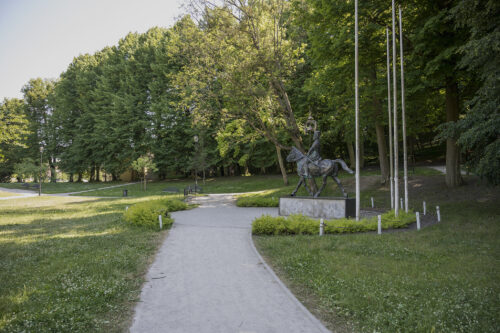
Place: The equestrian statue is located in close vicinity to the National Cultural Centre of Polish Tatars named after Leon Najman-Mirza Kryczyński. It stands in the picturesque, historic Orunia Park, next to the former seat of Gdańsk’s mayors.
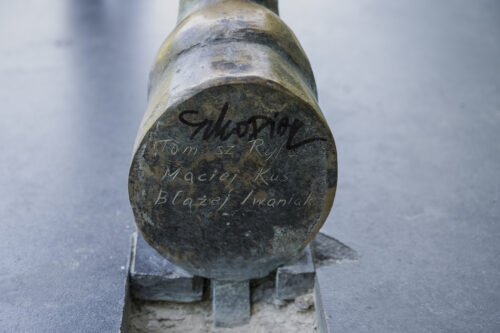
Information about the authors: Tomasz Ryfa (b. 1982 in Kłodzko) studied at the Faculty of Sculpture of the Academy of Fine Arts in Wrocław. He graduated from Prof. Christos Mandzios’s studio. He now runs a sculpture and design studio for artists and designers. He works with kinetic sculpture, records movement and shaping forces.
Maciej Kus graduated from the Faculty of Sculpture and Painting (Prof. Janusz Kucharski’s studio) of the Academy of Fine Arts in Wrocław in 2011. He now runs his own commercial sculpture studio “MASS” in Łódź. He has worked on commission from the Ministry of Culture, the Union of Polish Tatars, the Grudziądz Museum and Warsaw’s Theatre Academy, among others.
Condition of the object: very good
Owner/guardian: ZDiZ
Author of the entry: Kinga Jarocka

Sources:
Selim Chazbijewicz, “Pomnik Tatara polskiego,” Przegląd Tatarski, no. 2 (2011)
http://bibliotekatatarska.pl/wp-content/uploads/2015/07/pt10_srodek.pdf
Waldemar Kowalski, Pomnik Tatara Rzeczypospolitej Polskiej, www.gedanopedia.pl
https://www.gedanopedia.pl/gdansk/?title=POMNIK_TATARA_RZECZYPOSPOLITEJ_POLSKIEJ
Katarzyna Moritz, Prezydent Komorowski odsłoni pomnik Tatara RP i odbierze medal Gwiazdy Orientu, www.trojmiasto.pl
Okradziono pomnik polskiego Tatara, www.kontakt24.tvn.pl
https://kontakt24.tvn24.pl/okradziono-pomnik-polskiego-tatara-straty-50-tys-zl,25246.html
Michał Mackiewicz, Z półksiężycem na czapce. Mundur ułana Pułku Jazdy Tatarskiej ze zbiorów Wojska Polskiego, www.historiaposzukaj.pl
https://www.historiaposzukaj.pl/wiedza,obiekty,1127,obiekt_mundur_oddzialow_tatarskich.html
Karol Uliczny, Gdzie jest buńczuk z Pomnika Tatara RP w Parku Oruńskim w Gdańsku? To nie wandale, monument przejdzie renowacje,


Help us build the database of art objects in Gdańsk by filling in the form and adding photographs.