


Have we missed something?
Help us build the database of art objects in Gdańsk by filling in the form and adding photographs.

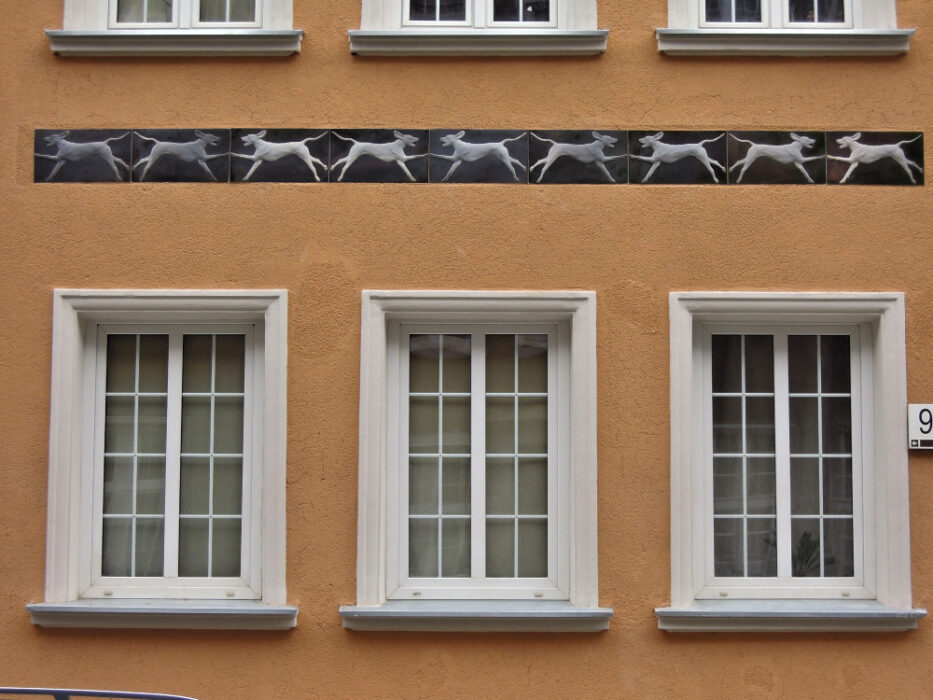
Object: A tenement building for which two designs were created, with the first one not meeting the artist’s approval. After the plaster dried, the painter concluded that the intended effect had not been achieved, and the façade’s colours were too garish. Owing to the cost of redoing the work, the Technical Council, which was responsible for approving the completed façades, tied any changes to the decoration to the opinion of the Minister of Construction. The Minister, Aleksander Wolski, refused permission despite the artist’s personal appeal. Determined to ensure the building received a fitting decoration, Wnukowa damaged her own sgraffito with a sharpened hoe. Confronted with the fait accompli, the Technical Council accepted her new designs. The ‘St. Christopher House’ – its name deriving from a sculpture from a now-lost stoop – is adorned with sgraffito depicting a grape harvest. Up to the height of the first floor, it imitates pilasters and bossage. The panel above the entrance depicts Bacchus with a goblet amidst grapevines populated by birds. Birds eating the fruit are also depicted above two ground-floor windows. The frieze above the first floor features satyrs, birds, a goat, and Flora.
Location: The painted decoration was created as part of an effort by artists – primarily lecturers and students of the State School of Fine Arts in Gdańsk (PWSSP) – to contribute to the reconstruction of Główne Miasto, which had been heavily damaged in 1945. Długa Street and Długi Targ were among the first areas to be rebuilt. The most valuable tenements were faithfully reconstructed, while others were given stylistic adaptations inspired, more or less, by their pre-1945 appearance. These restored façades were intended to serve as a backdrop for the reconstructed historical monuments.
Information about the author: Józefa Wnukowa (b. 1911 in Warsaw, d. in Sopot in 2000) studied at the Academy of Fine Arts in Warsaw, and afterwards lived in Paris and Lviv. During World War II, she was active in the resistance and participated in the Warsaw Uprising. She moved to Sopot in 1945, becoming a key figure in the emerging artistic community on the Baltic Coast. A long-time lecturer at PWSSP, she contributed to the reconstruction of Gdańsk’s Główne Miasto tenements (1952–1955) and decorated the interiors of the Główne Miasto Town Hall in 1970. In addition to architectural painting, she worked in easel painting, textile art, and designed opera set designs and costumes.
Condition of the object: partially damaged
Owner/guardian: private object
Author of the entry: Klaudiusz Grabowski

Sources: Wspomnienia z odbudowy Głównego Miasta, vol. 1, ed. by Izabella Trojanowska (Gdańsk, 1997); Wspomnienia z odbudowy Głównego Miasta, vol. 2, ed. by Izabella Greczanik-Filip (Gdańsk, 1997)
Literature:
Dekoracje architektoniczne Gdańska 1945–1989, vol. 1, Główne Miasto – fresk, sgraffito, mozaika, ceramika, ed. by Jacek Kriegseisen (Gdańsk, 2016)
Jacek Friedrich, ‘Malarstwo monumentalne’, in Akademia Sztuk Pięknych w Gdańsku 1945–2005 (Gdańsk, 2005)
Jacek Friedrich, Odbudowa Głównego Miasta w Gdańsku w latach 1945–1960 (Gdańsk, 2015)
Jacek Friedrich, ‘Wystrój dekoracyjny Drogi Królewskiej w Gdańsku w latach 1953–1955’, Gdańskie Studia Muzealne, Ann. 6 (1995)
Katalog zabytków sztuki w Polsce, Gdańsk Główne Miasto, ed. by Barbara Roll, Iwona Strzelecka (Warsaw, 2006)
Jan Kołodziej, Barbara Brzuszkiewicz, ‘Kształtowanie tożsamości miejsca poprzez konserwację istniejących i wykonanych nowych dekoracji artystycznych dla fasad kamienic odbudowanych po 1945 r. na obszarze Głównego Miasta w Gdańsku’, in Polichromie i sgraffita na fasadach ośrodków staromiejskich odbudowanych po 1945 r. Kreacja i konserwacja, ed. by Anna Jagiellak, Paulina Świątek (Warsaw, 2015)
Anna Kriegseisen, ‘Starogdańskie kamieniczki pełne nowej treści – dekoracje fasadowe czasu odbudowy 1945–1960, czyli technologia w służbie ideologii’, in Gdańsk 1945–1990. Materiały–studia–analizy, vol. 1, ed. Edmund Kizik, Mirosław Golon (Gdańsk–Warszawa, 2017)
Anna Kriegseisen, ‘W poszukiwaniu straconego koloru. Wystrój barwny zachowanych i odbudowanych fasad Głównego i Starego Miasta Gdańska’, in Polichromie i sgraffita na fasadach ośrodków staromiejskich odbudowanych po 1945 r. Kreacja i konserwacja, ed. by Anna Jagiellak, Paulina Świątek (Warsaw, 2015)
Franciszek Mamuszka, Droga Królewska w Gdańsku (Gdańsk, 1972)




Help us build the database of art objects in Gdańsk by filling in the form and adding photographs.