


Have we missed something?
Help us build the database of art objects in Gdańsk by filling in the form and adding photographs.
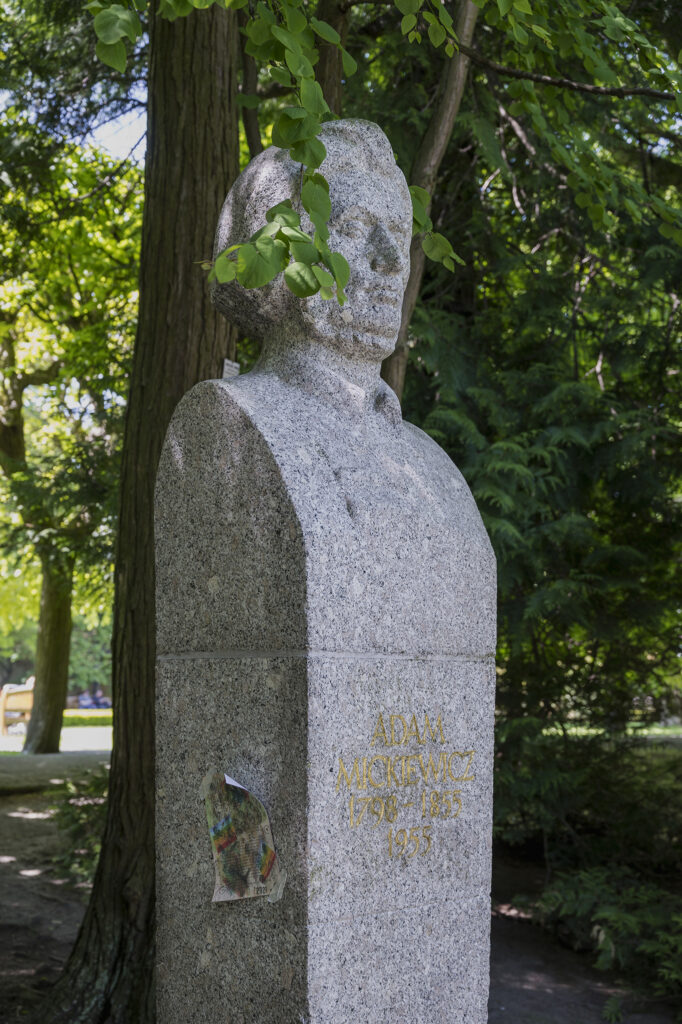
Technique: stone carving, granite
Dimensions: 225 cm x 190 cm x 140 cm, Height of the entire monument together with its base: 305 cm
Object:
The statue of Adam Mickiewicz was installed in the Oliwa Park in 1955. It was created for the commemoration ceremonies of the hundredth anniversary of the Polish Romantic era poet’s death. The statue takes the form of a herma (bust). The pedestal, with a narrowing downwards form, is crowned with a cube featuring a bust of Mickiewicz. Both the massive, shoulderless bust and the pedestal are made of the same material – light grey granite. The representation of Mickiewicz is characterised by its realism, with emphasis placed on the poet’s individual features known from numerous iconographic sources. The visibly synthetic sculpting work of the head is something that draws attention, the hairstyle in particular, which, together with the beard, completely surrounds the face. The frontal, static and delicately modelled image of the Polish poet exudes focus and peace.
The following inscription is carved on the front of the pedestal: ADAM MICKIEWICZ 1798–1855/ 1955. The monument was designed by Konstanty Lech. Commissioned by the Culture Department of the Presidium of the City National Council in Gdańsk, the monument was carved in stone by Franciszek Drozd, a graduate of the Gdańsk State School of Fine Arts (now the Academy of Fine Arts).
Location:
The statue of Adam Mickiewicz is in Oliwa Park. The sculpture is located on the ground floor garden, paradisum, perpendicularly adjacent to the baroque part of the garden, established in front of the former residence of Pelplin abbots (now the National Museum’s Modern Art Department). The entire park and garden has, since 1955, been named after Adam Mickiewicz.
Information about the authors:
Konstanty Lech (born 1909 in Maoershan, China, died 2001 in Sopot) served on Navy ships in Gdynia in the 1930s. In 1934 he was promoted to lieutenant. During World War II, he was in the Woldenberg oflag (POW camp), where he learned to sculpt under the tutelage of Stanisław Horno-Popławski. After 1945, he served as the manager of the art studio of the Navy House (Dom Marynarki Wojennej) in Gdynia, and then he became the manager of the entire facility. He became a member of the Gdańsk chapter of the Association of Polish Artists and Designers (ZPAP) in 1945. As a sculptor, he participated in regional and national exhibitions. In 1952, he started social work within the Association of Polish Artists and Designers as the sculpture section’s chairman, and then, for one term – served as the chairman of the board for the Gdańsk District. In 1953–1954 he worked on the reconstruction of the sculptures belonging to the Royal Route in Gdańsk.
Franciszek Drozd (born 1919, passed in 1991 in Gdańsk) studied in the 1949–1953 period at the Faculty of Sculpture of the State School of Fine Arts in Gdańsk, under the supervision of, among others, prof. Stanisław Horno-Popławski. After graduating, he worked as a stonemason during the reconstruction of Gdańsk. He was then tasked with the reconstruction of sculptures, bas-reliefs and figures of historic buildings in the Main City. Franciszek Drozd and his team also participated in the implementation of a number of other sculptures, such as the monument to Adam Mickiewicz in Warsaw by Stanisław Horno-Popławski, the monument at the Death Camp in Treblinka by Franciszek Duszeńko and the Monument to the Heroes of Westerplatte by Franciszek Duszeńko and Henryk Kitowski. Drozd was the author of the ceramic penguin sculpture at the zoo in Oliwa.
Condition of the object: good
Owner/guardian: Gdańsk Road and Greenery Authority
Author of the entry: Andrzej Zagrobelny

Sources:
https://gzdiz.gda.pl/mapa/pomnik-adama-mickiewicza-w-oliwie,o,27
https://www.archikatedraoliwa.pl/wizyta-w-oliwie-4222/park-oliwski-4160
http://pzg.warszawa.pl/historia/nie-tylko-wspomnienia-autorstwa-olgierda-lecha/
https://staraoliwa.pl/historia/item/3000-helena-drozd.html
Bibliography:
– Franciszek Mamuszka, “Ekspozycja rzeźby w parku oliwskim,” in Oliwa. Okruchy z dziejów, zabytki (Gdańsk, 1985).


Help us build the database of art objects in Gdańsk by filling in the form and adding photographs.