

Have we missed something?
Help us build the database of art objects in Gdańsk by filling in the form and adding photographs.

Technique: sculptural installation, steel elements
Dimensions –
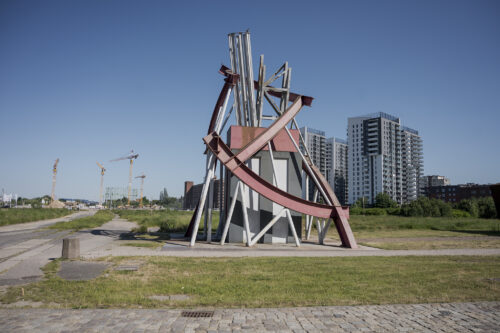
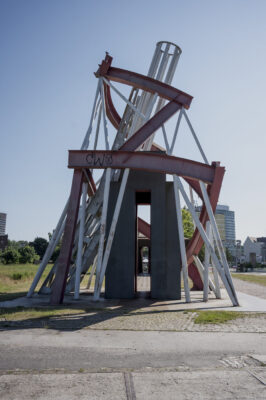
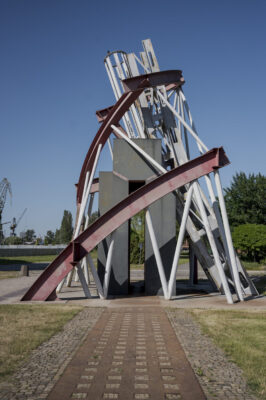
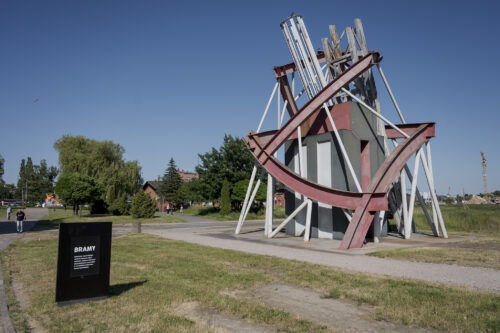
Object: The monumental Gates were prepared for the Roads to Freedom exhibition, which was organised in the Gdańsk Shipyard in 2000 by the ŁAŹNIA Centre for Contemporary Art to mark the 20th anniversary of signing the August Accords. Gate II symbolically refers to Gate I; they are connected with each other by a ramp. Together, they form an anti-monument that clearly moves away from national-patriotic symbolism and the tradition of commemorating historic events. The form of Gate II is a direct reference to the Monument to the Third International, which was meant to be erected in Leningrad as a manifesto of communist ideology. The concept was proposed by Vladimir Yevgrafovich Tatlin, a Russian painter and leading representative of Constructivism. The 400 m high building was also meant to represent the Soviet response to the Eiffel Tower, treated in the USSR as a symbol of rotten capitalism. The design was never implemented due to financial and technical constraints, but its model displayed in the courtyard of the London Royal Academy of Arts inspired artists from all over the world, becoming the most famous symbol of constructivist architecture.
The truncated spiral in Prof. Klaman’s work refers to the closure of reflection on social and class ideology. The gate’s structure – the destruction of Tatlin’s form – symbolises the disintegration of totalitarian ideology. Grzegorz Klaman’s Gates were not only meant to commemorate, but also to formulate concepts, disrupt historical memory, ask questions and expose the unspoken.
Place: Gate I and Gate II are located in the axis of Gdańsk Shipyard’s historic gate no. 2. Their colour and form inspired the designers of the European Solidarity Centre, built several years later (the institution also keeps other elements of the Roads to Freedom exhibition). Grzegorz Klaman’s Gates were created in cooperation with employees of the Gdańsk Shipyard Design Office, and the structure itself was built by the Gdańsk-based Mostostal company. Now, even though the design office, Mostostal and numerous other entities that were active in the shipyard’s heyday no longer exist, Klaman’s Gates remain, acting as a testament to bygone times and human work.
Information about the author: Grzegorz Klaman (born in 1959) graduated from the Faculty of Sculpture of the State School of Fine Arts in Gdańsk (now Academy of Fine Arts). He obtained his degree in 1985 in the studio of Prof. Franciszek Duszeńko. Since 1984, he has been working to stimulate various areas of Gdańsk through art, including the Granary Island and the former public baths. Klaman was the co-founder and manager of Wyspa Gallery (until 2012) and Wyspa Progress Foundation, and co-initiator (with Aneta Szyłak) of establishing the ŁAŹNIA Centre for Contemporary Art. He organised and took part in several hundred exhibitions, shows and workshops in Poland and abroad. His most important exhibitions include: Paradise Lost at the Centre for Contemporary Art in Warsaw (1990), Doppelte Indentität at the Landesmuseum in Wiesbaden (1991), Freedom / At Last in Kunsthalle Baden-Baden (2000), and In Between. Art In Poland 1945–2000 at the Chicago Cultural Center (2001). Between 2002 and 2013, he founded and ran the Modelarnia [Model Hall], a cooperative of artists in the former shipyard area, where he established the Wyspa Institute of Art with Aneta Szyłak (2004–2016). Klaman received a Fulbright scholarship from the Florida Atlantic University in Boca Raton. His work includes installations, public space interventions (large-scale objects and sculptures, performances), critical art and bio-art, analysing the discursive relationships between the body, power, knowledge and science.
Condition of the object: partially destroyed
Owner/guardian: European Solidarity Centre
Author of the entry: Kora Kowalska

Sources:
https://culture.pl/pl/tworca/grzegorz-klaman
https://infogdansk.pl/bramy-do-wolnosci/
https://sztukapubliczna.pl/pl/kazda-sztuka-jest-polityczna-grzegorz-klaman/czytaj/108
Bibliography:
Tu Stocznia, Fundacja Centrum Solidarności, Gdańsk 2013




Help us build the database of art objects in Gdańsk by filling in the form and adding photographs.