


Have we missed something?
Help us build the database of art objects in Gdańsk by filling in the form and adding photographs.

Technique: Sculpture (bronze casting)
Object: The first records of a fountain at the current location of the Neptune Fountain date back to 1549 and most likely refer to a well adorned with metal decorations. Due to the city’s growing prosperity and the subsequent increase in public commissions for representative buildings, the decision to create a new well was a logical consequence of the city’s policies. The first mention related to the planning of a new fountain comes from around 1603–1605, in a letter from goldsmith Jacob Kordes to the City Council, which included an unrealized project. In 1606, Abraham van den Blocke began work on a fountain made of black stone, most likely black marble from Namur. Due to the work on the facade of the Great Armoury and the altar at St. John’s Church, the fountain’s construction continued until 1613. It is certain that the design of the basin, shaft, and bowl must have existed from the very beginning of the project, as Isaac van den Blocke – Abraham’s brother – depicted the non-existent fountain’s stonework in his painting Apotheosis of Gdańsk from 1608, which aligns with the later realization, meaning it must have been known to him. However, it seems unlikely that the design was created by Abraham van den Blocke, as during that time, such concepts were usually made by painters. The question of who prepared the design remains open, but it seems most likely that it was based on graphic templates.
In 1612, Peter Hausen began work on preparing a model, which was probably cast in 1614 by the bell founder Gerd Benningsen. Further work on chiseling the sculpture was completed in the summer of 1615. Despite the completed elements, the first attempts to launch the fountain only took place in 1621 and were unsuccessful due to a faulty water installation. This delay was most likely caused by construction work on the facade of the Artus Court, where the sculpture was to be placed, followed by the city’s involvement in the Thirty Years’ War, leading to a budget deficit. During this period, the statue was stored in the Great Armoury, where it was made available to the residents and visitors of Gdańsk. Fortunately, the fountain was finally launched on October 9, 1633. The fountain’s iron grille was commissioned to Johann Rogge.
In 1757, a decision was made to carry out renovation work – Johann Carl Stender created a new basin and pedestal from sandstone, while the original pedestal and upper bowl were preserved. At this time, the grille was also renovated and adorned with coats of arms of Gdańsk and Poland on the gates. The work was completed in 1761. Another renovation took place in 1927, but the source materials have not been preserved. The wartime destruction of 1945 forced the dismantling of the fountain, and the statue of Neptune along with the grille was transported to the area of Bytów (Parchowo). The fountain was recreated in 1954 according to the design by Tadeusz Godziszewski, with Zacheusz Pypeć casting the shaft, and Stanisław Goździelewski creating the new trident. The grille required further conservation due to the destruction of the Polish eagles in 1935, which were again crafted by Stanisław Nowakowski. In 1976–1977, the stonework was renovated, and in 1979, the figure of Neptune was restored. The last dismantling of the statue, followed by conservation, was completed in 2012.
The balustrade of the basin is decorated with Rococo ornamentation, supplemented by depictions of sea creatures: to the north – a seahorse, to the south – a mermaid, to the west – a triton and mermaids, and to the east – a sea dog and putto. The shaft supporting the bowl, with four mask heads, is adorned with a motif of flowing water. At the central point, a Mannerist bronze statue of Neptune is placed on the pedestal, whose figure may draw inspiration from ancient sculptures – the head of Marcus Aurelius from the Capitoline equestrian statue, or the Belvedere Torlonia – with a trident and a seahorse at its feet. The entire arrangement is surrounded by a wrought-iron grille with four gates, featuring heraldic motifs – the coat of arms of Poland to the east and west, and the coat of arms of Gdańsk to the north and south, with smooth, sharply pointed bars interwoven with floral ornaments.
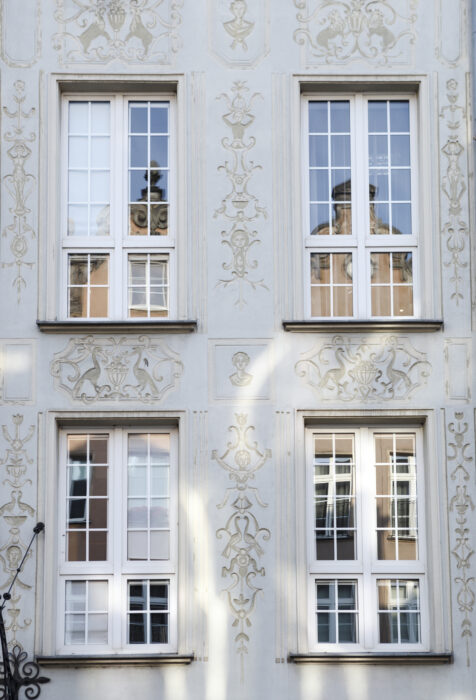
Location: The fountain is located at Długi Targ, the most representative part of the city, aligned with the facade of the Artus Court, visible directly from the windows of the so-called Royal Tenements across the street.
Information about the authors:
Abraham van den Block – born in 1572, died in 1638. Sculptor, architect, and citizen of Gdańsk since 1596. He initially learned the craft from his father, then traveled to the Netherlands to hone his skills. From 1597, he was a master of the bricklayers’ and sculptors’ guild, from 1610, a city sculptor, and from 1611, a city architect. He was responsible for the realization of the largest public projects in Gdańsk during the first half of the 17th century, including the altar at St. John’s Church, the eastern facade of the Great Armoury, and the decoration of the Artus Court.
Peter Hausen – sculptor, year and place of birth unknown, his educational background and travels to Southern Europe remain unknown. No source materials have been found to date.
Object Condition: Good
Owner/Guardian: Gdańsk Waterworks
Author of the Entry: Noemi Etush

Albert Boesten-Stengal, Gdańsk nad Morzem Śródziemnym. Rzeźba z brązu Fontanny Neptuna – ikonografia, forma i znaczenie, „Porta Aurea” 2013, t. 12.
Jacek Friedrich, Gdańskie zabytki architektury do końca XVIII w., Gdańsk 1997.
Lars Olaf Larsson, Studnia Neptuna na Długim Targu w Gdańsku, „Porta Aurea” 2011, t. 10.
Marcin Kaleciński, Gdańska Fontanna Neptuna, „Porta Aurea” 2013, t. 12.
Lech Krzyżanowski, Fontanna Neptuna, [w:] Katalog Zabytków Sztuki. Gdańsk Główne Miasto, red. B. Roll, I. Strzelecka, cz. 1., Warszawa 2006/
Wacław Strzelecki, Gdańska Studnia Neptuna, „Ochrona Zabytków” 1959, 12/3–4/
https://www.gedanopedia.pl/gdansk/?title=BLOCK_ABRAHAM_van_den
https://www.trojmiasto.pl/wiadomosci/Odkrywamy-tajemnice-fontanny-Neptuna-n70517.html
https://www.trojmiasto.pl/wiadomosci/Neptun-zniknie-z-Dlugiego-Targu-w-Gdansku-n46236.html
https://www.trojmiasto.pl/wiadomosci/Powrot-krola-Neptun-wraca-na-Dlugi-Targ-n57325.html




Help us build the database of art objects in Gdańsk by filling in the form and adding photographs.