

Have we missed something?
Help us build the database of art objects in Gdańsk by filling in the form and adding photographs.

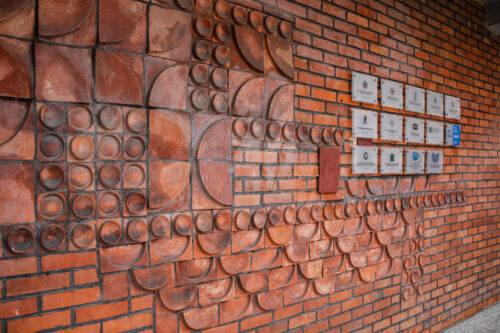
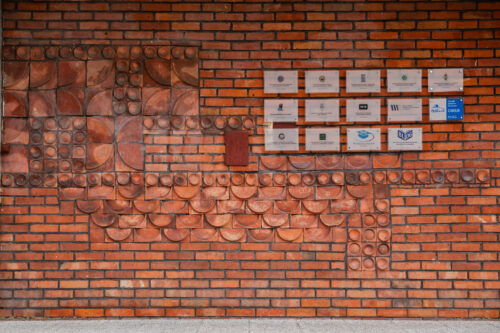
Technique: fired ceramic plates
Dimensions: –
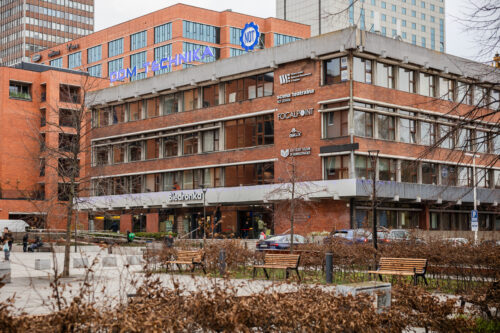
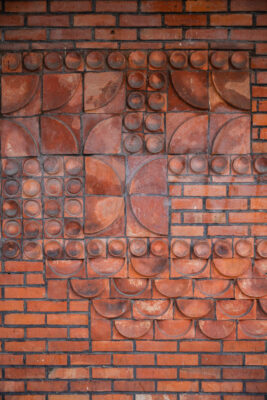
Object: The ceramic decoration of the façade of Dom Technika NOT (Technician’s House of the Polish Federation of Engineering Associations) is a follow-up on the building’s interior design. It is a total work, in which architecture coexists with the decorations. The main hall walls are decorated with a mosaic composed of brick-coloured fired ceramic plates, which form an abstract, geometric composition. Identical round elements appear on the building’s façade. Inside, in the axis of the staircase, is an abstract composition of glazed ceramic tiles. A similar mosaic used to decorate the bar inside the building. The whole concept was designed and created by the visual artist Andrzej Trzaska.
Place: The Polish Federation of Engineering Associations (Naczelna Organizacja Techniczna; NOT) was established in 1945; the Committee for the Construction of the Technician’s House was formed in 1960. In the 1960s and 70s, NOT built new headquarters in many Polish cities to emphasise progressive Polish technical thought. Their structure was also meant to promote modern architectural forms. In April 1963, an architectural competition was announced for the development of the area of Rajska Street in Gdańsk. The winning design was proposed by architects Bolesław Kardaszewski and Ludwik Mackiewicz. The idea was to build a department store (on the site of the later Madison), a large hotel (on the site of the later Hevelius), a shopping pavilion, a fast food bar, a Teacher’s House and a Technician’s House. Owing to financial difficulties, the project was scaled down to only the Teacher’s House and the Technician’s House. A closed architectural competition for the Technician’s House was concluded at the end of August 1965 (with only six design offices from the Polish coastal area participating). The first prize went to a team made up of Szczepan Baum, Zbigniew Budzyński and Danuta Olędzka. Preparations for the construction started towards the end of 1969 with the liquidation of the only guarded car park operating in downtown Gdańsk at the time. The earthworks began in 1970, the building shell was ready in 1971, and the completed building was commissioned on 30 March 1974. A plaque listing the founders of the Technician’s House was placed on the front of the building. The contractor was Gdańskie Przedsiębiorstwo Budownictwa Miejskiego (Gdańsk Urban Construction Company). The building, with a cubic capacity of 33 430 m³, had four overground storeys (with a terrace on the ground floor) and a basement. At the time of its opening, it boasted a 450-seat auditorium, eight conference rooms, a bookshop, a reading room and library with technical magazines, a club with a café, as well as a restaurant. The building housed the NOT Voivodeship Branch, Voivodeship Club of Technology and Rationalisation, a technical information centre and French technical documentation centre (with a language lab), the Budownictwo Okrętowe (Shipbuilding) publishing house and offices of 17 technical associations. The modernist building was erected in the city centre, with the architects giving it original decorations through the use of various materials: brick, concrete, plaster, glass, and also wood on the inside. The materials and forms enter into a dialogue with the historical architecture of Gdańsk. The Technician’s House is a prime example of cooperation between architects and a visual artist, which was appreciated already in 1974, at the Le Mur Vivant exhibition in Paris.
Information about the author: Andrzej Trzaska (born in 1935, died in 2019) graduated in painting from the State School of Fine Arts in Wrocław and continued his studies in Gdańsk. Together with a group of students of Prof. Hanna Żuławska, he worked in her famous Kadyny studio – an experience that had a major impact on his future ceramic practice. Trzaska made his début at the Kadyny group exhibition held at Warsaw’s Kordegarda in 1957. However, the exhibition’s success and the studio’s enormous potential were squandered. Work started in Kadyny on designing ceramics for industrial production, but unfortunately it ended in failure. Trzaska worked on his own with the Central Office of the Folk and Art Industry (Cepelia) and in the early 1960s joined the Włocławek-based “Przyjaźń” (“Friendship”) Cooperative. Before Trzaska took over as art manager, the plant had mostly produced flower pots. Within a few years, he introduced many decorative and utility ceramics: platters, candlesticks, vases, etc. Despite a certain level of standardisation in the output of Cepelia cooperatives, Włocławek designs show the influence of Kadyny experience and Trzaska’s individual style. He was also the author of various mosaics and ceramic decorations in Gdańsk.
Object condition: awaiting renovation
Owner/guardian: Naczelna Organizacja Techniczna (Polish Federation of Engineering Associations)
Author of the entry: Kora Kowalska

Sources:
https://www.gedanopedia.pl/gdansk/?title=DOM_TECHNIKA
https://dziennikbaltycki.pl/wystawa-w-instytucie-sztuki-wyspa-mozaiki-trojmiasta-trzeba-je-ratowac/ar/1007333
Bibliography:
https://artinfo.pl/artysci/andrzej-trzaska
https://gdansk.enot.pl/aktualnosci/open-house-gdansk-zapraszamy-do-domu-technika?department=gdansk







Help us build the database of art objects in Gdańsk by filling in the form and adding photographs.