

Have we missed something?
Help us build the database of art objects in Gdańsk by filling in the form and adding photographs.

Technique: sculptural installation, steel elements
Dimensions –
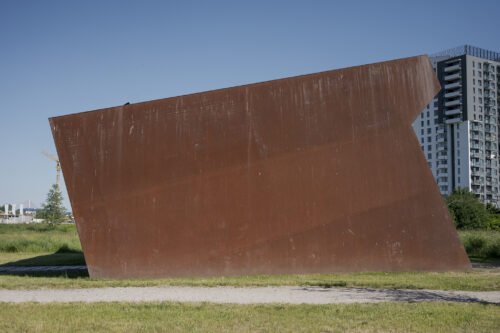
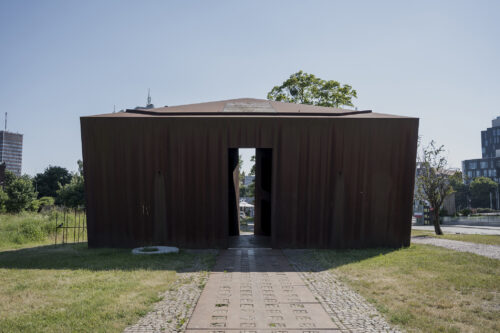
Object: The monumental Gates were prepared for the Roads to Freedom exhibition, which was organised in the Gdańsk Shipyard in 2000 by the ŁAŹNIA Centre for Contemporary Art to mark the 20th anniversary of signing the August Accords. In Gate I, Grzegorz Klaman makes a formal reference to the bow of a ship. The sculpture has a vertical opening that allows one to get inside. Upon entering, the viewer found himself between two electronic text displays that showed quotes from publications and statements representative of totalitarian and democratic systems (without stating the authors). Displayed on the walls were quotations and slogans of communist ideologues on one hand and statements made by oppositionists and human rights defenders on the other. “Once inside Gate I, there were texts displayed on both sides, and if you started to read them, you’d experience vertigo, you’d start feeling dizzy, your labyrinth would go haywire. You check the ground beneath your feet. The side walls form slopes. This is clearly made for that. The human body begins to stagger. The sculpture has a direct impact on the viewer’s body, that’s what I was after. And people wanted to leave, because they felt sick”, explained the artist. A huge, rusty red ship emerging from the ground symbolises the beginning of the communist era: monumental and impressive from the outside, it is cramped, claustrophobic and imbalanced inside. This reflects the communist order, which was fair and progressive at first sight, but in fact full of disproportion and internal contradictions. As the author stated: “(…) this rusty steel bow was like a testimony to the sinking of communism and to how this shipyard quite literally went under, along with its Bolshevik heritage”. Gate I is connected with Gate II by a ramp, creating a coherent concept. It is an anti-monument that clearly moves away from national-patriotic symbolism and the tradition of commemorating historic events. The structure of Gate I intentionally triggers a sensation of imbalance. The dizziness the viewers experience is associated with indoctrination translated into a psychophysical experience. Once the exhibition ended, the displays were dismantled, the interior lighting is currently also inoperative, and the installation as a whole is damaged and vandalised.
Place: Gate I and Gate II are located in the axis of Gdańsk Shipyard’s historic gate no. 2. Their colour and form inspired the designers of the European Solidarity Centre, built several years later (the institution also keeps other elements of the Roads to Freedom exhibition). Grzegorz Klaman’s Gates were created in cooperation with employees of the Gdańsk Shipyard Design Office, and the structure itself was built by the Gdańsk-based Mostostal company. Now, even though the design office, Mostostal and numerous other entities that were active in the shipyard’s heyday no longer exist, Klaman’s Gates remain, acting as a testament to bygone times and human work.
Information about the author: Grzegorz Klaman (born in 1959) graduated from the Faculty of Sculpture of the State School of Fine Arts in Gdańsk (now Academy of Fine Arts). He obtained his degree in 1985 in the studio of Prof. Franciszek Duszeńko. Since 1984, he has been working to stimulate various areas of Gdańsk through art, including the Granary Island and the former public baths. Klaman was the co-founder and manager of Wyspa Gallery (until 2012) and Wyspa Progress Foundation, and co-initiator (with Aneta Szyłak) of establishing the ŁAŹNIA Centre for Contemporary Art. He organised and took part in several hundred exhibitions, shows and workshops in Poland and abroad. His most important exhibitions include: Paradise Lost at the Centre for Contemporary Art in Warsaw (1990), Doppelte Indentität at the Landesmuseum in Wiesbaden (1991), Freedom / At Last in Kunsthalle Baden-Baden (2000), and In Between. Art In Poland 1945–2000 at the Chicago Cultural Center (2001). Between 2002 and 2013, he founded and ran the Modelarnia [Model Hall], a cooperative of artists in the former shipyard area, where he established the Wyspa Institute of Art with Aneta Szyłak (2004–2016). Klaman received a Fulbright scholarship from the Florida Atlantic University in Boca Raton. His work includes installations, public space interventions (large-scale objects and sculptures, performances), critical art and bio-art, analysing the discursive relationships between the body, power, knowledge and science.
Condition of the object: partially destroyed
Owner/guardian: European Solidarity Centre
Author of the entry: Kora Kowalska

Sources:
https://culture.pl/pl/tworca/grzegorz-klaman
Bibliography:
https://sztukapubliczna.pl/pl/kazda-sztuka-jest-polityczna-grzegorz-klaman/czytaj/108
http://fcs.org.pl/projekt/tu-stocznia/
Tu Stocznia, Fundacja Centrum Solidarności, Gdańsk 2013






Help us build the database of art objects in Gdańsk by filling in the form and adding photographs.